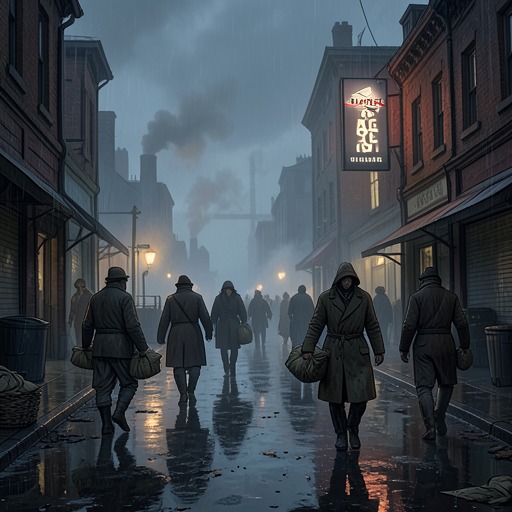
Steve
The ThicketSteve is the pimp who controls Jimmie Sue’s life at the whorehouse, and his importance lies less in his physical presence than in the system of coercion he represents. He presents exploitation as opportunity, turns a vulnerable young woman’s desire to leave home into sexual labor, and then remains close enough to regulate her movements and choices. The narrative exposes him chiefly through Jimmie Sue’s testimony, making his power visible as a pattern of promises, confinement, and violence rather than as a single dramatic act.
Identity and Introduction
Steve is first encountered indirectly at the whorehouse, where he functions as its armed gatekeeper and proprietor of access. When Jack Parker enters during the day, a man sits in the hallway facing the door with an old .410 lever-action shotgun across his knees. The weapon makes the building’s hospitality conditional: visitors are watched, and the women inside are enclosed within a place that resembles a household while operating through threat and commercial sexual control. Later, Steve comes out without the shotgun, spits over the porch, stretches, and returns indoors. His casual movements contrast sharply with the weapon and authority associated with him, making domination appear routine rather than exceptional.
Steve is also identified through the women’s practical knowledge of his presence. Jimmie Sue recognizes his boots, including the silver toes he uses to kick men. She says he boasts to the women about kicking men in the knees and balls, while Katy, his cousin, regards the behavior as amusing. The boots therefore become a compact emblem of his violence: a personal accessory transformed into an instrument of intimidation and a source of masculine boasting.
Recruitment and Exploitation
Jimmie Sue explains that Steve found her at the train station in Austin after she had run away from home. She had resisted her mother’s wish that she become a seamstress and regretted leaving when she discovered what awaited her. Steve told her that he loved her and would take her to better things; instead, he brought her to the whorehouse, where she was made to work as a prostitute. His promise of romantic rescue thus becomes the mechanism by which he obtains control. The contrast between what he said and what happened defines his character more clearly than any self-description could.
The material comforts of the whorehouse sharpen rather than soften the deception. Jimmie Sue notes its electric lights, gas burner, and indoor toilets, conveniences unusual in the town, but insists that these advantages do not make her life good. Steve’s version of the future was therefore built from visible improvements that concealed the loss of freedom beneath them. The house can offer electricity and running water while still functioning as a site of confinement and sexual labor.
Jimmie Sue’s account also reveals that Steve did not merely place her in the whorehouse and leave her to negotiate its dangers. After picking her up at the depot, he arranged for a group of men to assault her and described the assault as “breaking me in.” The phrase reduces organized sexual violence to occupational preparation. It shows how Steve converts bodily violation into a business procedure and how language helps him disguise coercion as initiation.
Relationship with Jimmie Sue
The relationship between Steve and Jimmie Sue combines emotional manipulation, economic dependence, and the threat of physical force. She once believed his claim that he loved her and would carry her toward a better life; afterward, the supposed romance becomes inseparable from prostitution. Her later willingness to leave with Jack Parker is shaped by the knowledge that Steve’s promise was false, not by any confidence that escape will be safe or permanent.
Even while she is preparing to go, Jimmie Sue describes herself as having limited alternatives. She says she has nowhere else to go but with Jack, admits that she may run off later, and imagines becoming an independent contractor in her profession. That language is both comic and revealing. It gives her a fragment of strategic control over a trade imposed on her, while also showing how thoroughly Steve’s arrangement has narrowed the available choices. Her possible independence is not a secure freedom outside the system; it is an attempt to survive by renegotiating the terms of labor.
Her anger toward Steve is intensified by the recognition that Jack’s sister has suffered from men of the same kind. When Fatty Worth is beaten, Jimmie Sue says that the sound is pleasing because it recalls what was done to her and because men like him have abused Jack’s sister. Steve’s violence is therefore not treated as an isolated personal defect. It belongs to a broader chain in which men recruit, purchase, assault, and discipline women, then rely on one another’s silence and complicity.
Conflict and Narrative Function
Steve’s authority is briefly exposed when Jimmie Sue leaves the whorehouse with Jack Parker and the others. His ordinary routine of spitting, stretching, and returning inside suggests a man confident that the house and its women remain under his control. Against that confidence, Jimmie Sue’s departure creates a small but meaningful reversal: she moves from being watched and commercially available to becoming an active participant in Jack’s dangerous search for Lula Parker.
The narrative does not grant Steve a redemptive explanation or a direct confrontation in the supplied scenes. Instead, it makes him legible through the testimony of the woman he deceived and through the physical signs of his power: the shotgun, the guarded hallway, the silver-toed boots, and the men recruited to “break in” a new worker. His character is consequently structured around the gap between public normality and hidden coercion. He can appear to be a man who spits on a porch and stretches in the daylight, yet the account attached to his name is one of sexual exploitation and enforced dependence.
Steve also participates in the book’s larger pattern of criminal labeling and social hierarchy. The surrounding world readily reduces people to categories such as pimp, whore, bank robber, or racialized slur, but Jimmie Sue’s testimony restores the history erased by those labels. Steve remains largely seen from the consequences of his conduct, while Jimmie Sue emerges as someone whose imposed identity contains memory, anger, calculation, and the desire to escape. His narrative role is therefore to embody the ordinary face of predatory power: not only spectacular outlaw violence, but the quieter arrangement that turns promises of love into captivity and makes exploitation look like a livelihood.